
Photo Credit: Ed Wolfstein
By Michael Liebermann
Will Greenberg thought Hanan Haimov fixed cars for a living. When the two first met at a wrestling club in Bat Yam, two days before the freestyle competition at the 2026 Maccabiah, they swapped Instagrams, and Haimov’s feed was full of posts of the man around motor vehicles. So it made sense to think that was his occupation.
“I had no idea,” Greenberg says now.
Not yet. What he did have then was a scouting report on the Israeli wrestler who was his principal competition in the heavyweight class at the Maccabiah. At the wrestling club, Greenberg’s older teammate, MB Klyman, introduced the pair with these words — “you two are about to go to war in two days” — and by the look of Haimov, Greenberg quite agreed.
“He looked really, really strong and pretty powerful,” Greenberg said. “He was fast, too. So I was like, all right, this is gonna be legit.”

Greenberg, a 20-year-old sophomore at Bucknell from Cleveland, Ohio, was at his first Maccabiah. But wherever you go as a heavyweight wrestler, there exists a kind of bond with your competitors. Greenberg’s dad loves to tell a story from a high school state championship qualifying tournament his junior year, where six of the top eight wrestlers in the state were vying for four spots.
Two were going to be left out. Yet as the wrestlers waited for the finals, the six of them sat joking together in the cafeteria with peanut butter and jelly sandwiches.
When Greenberg got to the competition at the Wingate Institute in Israel, he and Haimov shook hands: Good luck. Greenberg earned a bye to the semifinals, and as he fought his way past his opponent, Haimov did the same on the adjacent mat, setting them up to meet in the final.
In the hour between the matches, Greenberg tried to overcome his exhaustion from the semifinal — and fight off the effects of foreign water. He retreated to a weight room in the hallway, a mercifully cool and quiet room, to rest.
Then he got up and went out to fight for a gold medal.
“It was actually very intense,” Greenberg says. “It was pretty crazy.”
“It was a lot of fun,” Greenberg’s coach, Rob Prebish, says. “Those are the matches I enjoy coaching.”

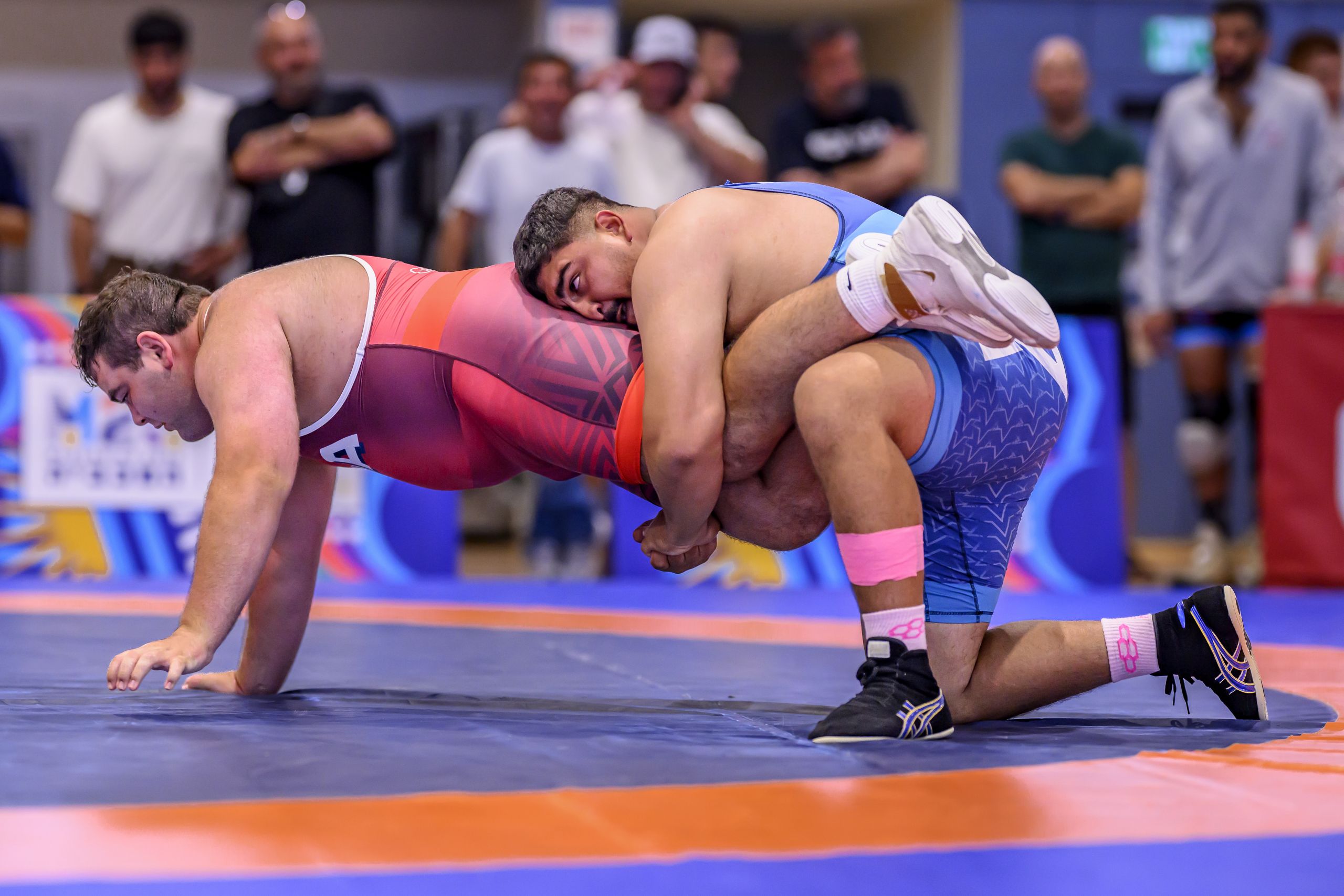
In the large, packed gym, people migrated from the benches on the walls to converge on one mat. Greenberg’s teammates massed near the coaches’ podiums, leaning forward intently to shout encouragement at the big guy in the red singlet.
After Greenberg scored first, Haimov got a four-point takedown, and then another four-point takedown, and then a two-point takedown. Greenberg just kept pushing in too much and getting thrown. He was in a hole.
Then he started coming back.
“Wear the guy out,” Prebish coached him.
That’s what he did, repeatedly forcing Haimov out of the ring. Point after point, Greenberg bulldozed the Israeli past the perimeter, huffed his way back to the center of the mat, and did it again when the whistle shrieked. Prebish kept in Greenberg’s ear: “You just gotta keep the pressure on him. He’s going to break. He’s not in good shape.”

With 30 seconds left, Haimov led 12-11. Greenberg leveled it with 20 seconds left, then rallied to secure the final point and win the match. He was a gold medalist.
But that was only half the story.
Greenberg and Haimov bonded over their kinship as heavyweights, and they had a tremendous match, their sweat running into each other during an epic final. But they never really expected to see each other again.
The next time the Games would be in Israel, Greenberg’s college wrestling career would be over. Who knows if he would keep slogging through the exacting, bruising rhythm of high-level wrestling. And Haimov would be deeper into his 20s, also past the age where most wrestlers become civilians. The odds were they would never see each other again — but fate had a different idea.
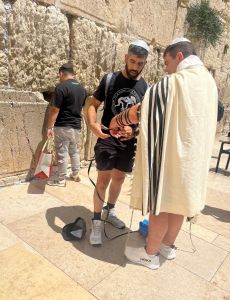 A few days later, Greenberg and his teammates were at the Western Wall, having made an early trip before one of their teammates flew home. It was an emotional experience for Greenberg, a Reform Jew on his first visit to Israel. Klyman wrapped tefillin for him, and halfway through, he started crying — “I don’t really cry a lot,” he said, “so that was cool.”
The experience, he said, was unparalleled. “Just that feeling you get. You only know if you’ve been, and you know what that feeling is when you start.” Greenberg has been going to Shabbat at school more often since, and he has imposed his own version of keeping the Sabbath. “I think that trip flipped the switch from ‘Oh, I have to do this’ to ‘I should be doing this, and I feel good when I do this,’” Greenberg says.
It was on his way out that one of the most impactful moments came.
Prebish had at least known that Haimov was something other than a mechanic. “I knew that he was a police officer,” Prebish says. But as the wrestling team walked up the ramp — Greenberg still wiping away his tears — the USA team saw the Israeli heavyweight standing in the plaza in his police gear. “Didn’t know that he was a police officer at the Wall,” Prebish said.
The wrestlers talked and hugged and took pictures. Haimov asked how Greenberg had done in the other competitions, Greco-Roman and Beach.
 “It was super cool,” Greenberg said. “We took a picture together. We were super excited to see each other.”
When Greenberg got home a couple weeks later, David Groverman, the Maccabi USA wrestling chair, got an email from Greenberg’s father, Joe. The email was stuffed with questions about the wrestling program.
Then Joe Greenberg called Groverman, and the wrestling chair knew what was up.
“I said, ‘Joe, let me guess,’” Groverman says. “‘Your son had a life-changing experience by going, by making this team.’ And he said, ‘Yes.’ That’s the bottom line. He came back completely recognizing the importance of Judaism.”
So interested was Joe Greenberg that he is taking over the wrestling chair position from the 74-year-old Groverman. Will Greenberg is — very quietly, very humbly — talking about the idea of trying to represent Israel, the country he grew connected to this summer, in the Olympics. If he ever pursues it, it will be a tall task.

Either way, he already has an Israeli wrestling singlet. After the heavyweight final, Greenberg and Haimov swapped uniforms. The Israeli singlet is currently hanging in Greenberg’s locker in Bucknell, and he’s worn it to practice a couple times, too, to the excitement of his teammates, who get to say their heavyweight is an international champion.
It is a reminder, a little bit, of the man he shared the mat with — and who helped guard him and his teammates.
“I told him, ‘Thank you for protecting us,’” Greenberg said.
Enjoy these additional photos of Will Greenberg from the 2026 Maccabiah.
(Photo credits: Ed Wolfstein, Jamie Margolis)