
By Ezra Lev Cohen
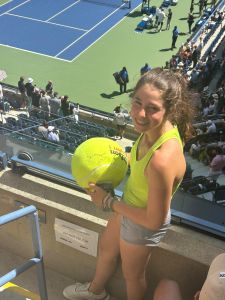
Seven years ago, Lea Krampf sat in the stands at the US Open Tennis tournament in New York City. In front of the 10 year old, star players smacked the ball back and forth at lightning speeds, leaving the young tennis player taken aback. At the end of one particularly hard-fought game, Great Britain’s top player, Emma Raducanu, tossed Krampf her towel.
 That experience, for Krampf, “was just amazing.” But she mentioned something else about that night which was more striking: the familial and communal aspects that this inherently solitary sport brings out. “Tennis is really something special,” she mused. “It brings people together. I was watching with my dad and my uncle, so that aspect of it, too, was definitely interesting.”
Decades prior and thousands of miles away, Krampf’s great-grandmother and namesake, Lea Klinosky, could never have imagined the life her descendants would build in the United States. It was the time of pogroms during World War II, along with the persecution that followed for Jews in the post war Soviet Union. According to family lore, Lea Klinosky took in and singlehandedly raised her grandchildren, including Lea Krampf’s mother, in St. Petersburg, Russia. This allowed her children to have time to work to feed their families. Still, in time, the tribulations of the old country overwhelmed the Krampf’s. So, when Lea’s mother was 10, the family uprooted to America.
“My mom only had, like, $10 when she came here,” Krampf explained.
For the first few months, the Krampf family was confined to a temporary shelter, brimming with immigrants, while they looked for housing and jobs. In hearing the stories of her parents’ struggles, Lea was taken aback.
“I’m just thinking, that was definitely hard. You know, living there without anything and barely any clothes. I can’t even go 5 seconds without skincare, and they definitely didn’t have any of that,” she reflected.
But it wasn’t long before the Krampf family “slowly built their way up,” as Lea explained. Her grandmother learned English and became an English teacher, while her grandfather retook his medical exams and became a doctor in America.
Today, Lea attributes her opportunities in life and her freedom to pursue athletics and sports to her great-grandmother’s sacrifices — even though the two never met.
“She was such a sweet, caring, kind person,” Krampf explained, citing stories she’d been told by her parents. “She always [welcomed] with open arms, anyone that walked into her house.”
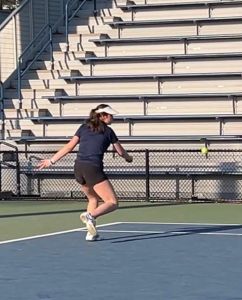
Having been raised on these stories of familial sacrifice, the youngest Krampf, now at 17, is sure to take full advantage of her freedoms. Perhaps the most prominent manifestation of these efforts can be seen in her tennis career, which began at the age of four, when Krampf picked up a racket for the first time.
 “When I was little,” Krampf explained, “my dad would always play with me, go to the park and hit against the wall in St. Catherine’s Park,” on the Upper East Side of Manhattan, just a few minutes from her home. As she grew, Lea found herself outrunning her father, and so, she recalled when he said: “It’s time to put you in something more.” Soon after, her love of the sport cascaded into a full-blown passion, as Krampf competed in tournaments, along with starring on her high school team.
“It’s definitely a big part of my life, which I’m glad that I do, and it definitely helps take my emotions out,” she explained. “If I’m angry or upset about something, whenever I go to practice or get on the court, it definitely helps me let go of those feelings.”
Ultimately, though, tennis is a very individual sport, and for the community-minded Krampf, it’s the classroom and the synagogue where she finds her interpersonal connections. She has taken full advantage at her small school, where she’s a star-studded student, and she plans on attending a big school after graduation: University of Miami, Tulane, and Indiana are all on the list. And of her synagogue, Krampf said, “I definitely am proud to be Jewish and appreciate the times that I go there.”
Since Lea was young, two Russian Matryoshka or “stacking dolls” have stood in her room. For most of her life, she saw them as “cool toys.” But recently, in her college essay, Lea reexamined them in the context of her own life.
“You take apart each one and each one reveals a different thing – about tennis, one aspect, my family, another,” she mused. Stacking one inside of the next, the dolls symbolize family, unity, and continuity. There is no question, Krampf’s great-grandmother would be proud.
Byline: Portland native Ezra Lev Cohen is currently studying abroad at Hebrew University in Jerusalem and reports for The Press Service of Israel as an intern. He’s a rising senior at Macalester College, majoring in Journalism and Geography. Find him on Instagram at @ezzy_reports and email him at: ezzycohen@icloud.com.