
By Michael Liebermann
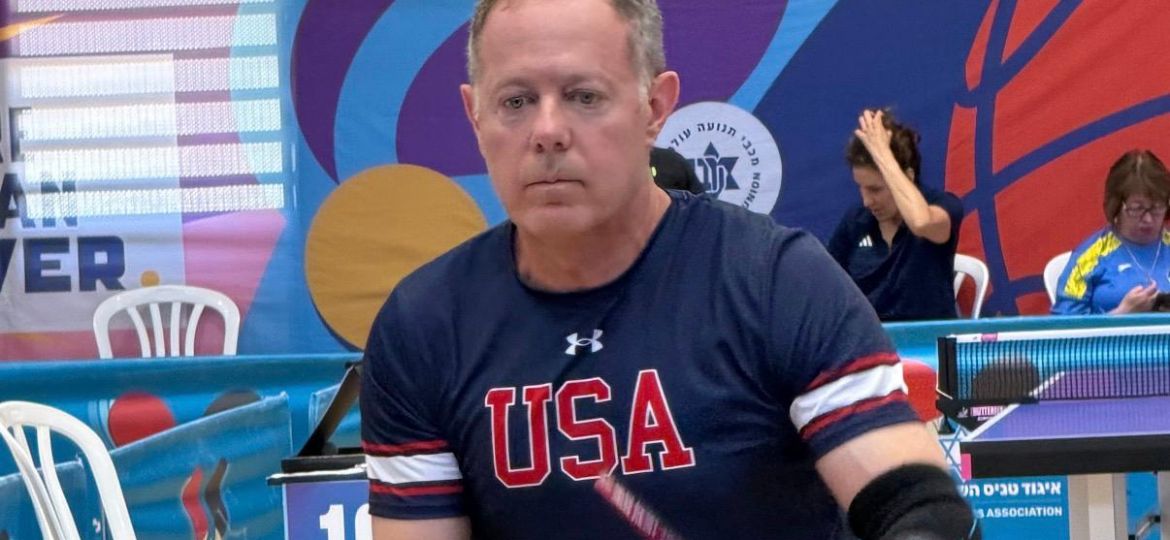
There’s a table tennis player here who’s not a table tennis player.
Gadi Slade is standing in the practice area at the Wingate Institute, talking to a teammate in Masters 40+, when three people walk up. They introduce themselves and tell him they heard about his story.
Slade tells his teammate he’ll follow him soon.
“Five minutes,” Slade says.
But he forgets the promise almost instantly. What are time constraints against century-old family history? For 10 minutes, the 55-year-old Slade tells the story, and that’s before any of the listeners even gets a word in.
The story is crystal clear. It might as well be inscribed on the walls of his brain. “My kids have heard it so many times,” Slade says. “My kids—especially one of my daughters—she would make fun of me. ‘Oh, Dad’s gonna tell the story again.'”
***
It goes like this.
In 1851, Slade’s great-great-grandfather, a Haredi Jew, a Rabbi, came to Palestine from Germany. Jews in Palestine at the time lived either in East Jerusalem or Tzfat. Great-great-grandpa Slade chose East Jerusalem.
In 1871, Slade’s great-grandfather, the non-religious son of this Haredi Rabbi, moved to Tzfat, looking for something to do with his life. Eleven years later, Baron Rothschild founded Zihron Ya’Akov, 35 kilometers south of Haifa in northern Israel, as the first modern agricultural town in Israel. The pictures of seven founders went up on a wall. Yosef Moshe Brauner’s was one of them, and he became the town pharmacist.
The pharmacy still exists. It’s now a McDonald’s.
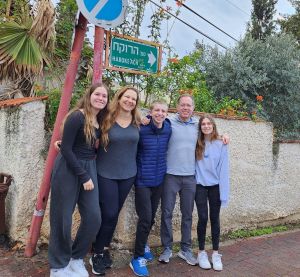
The city also named a street after Yosef Moshe Brauner, called Harokeah St., or Simchat Harokeach — “the alleyway of the pharmacist.”
Yosef Moshe Brauner and his wife produced nine kids, and of the five that survived malaria, all owned biblical names — Amnon, Matityahu, Carmeli, Yemima. Slade’s grandfather was called Zrubavel. He hated that. He changed his name to Billy.
Billy Brauner wanted nothing to do with farming, and he, like his father before him, stretched out the tendrils of his mind toward another life. He landed on medicine — he would be a doctor.
In 1914, the only medical school in the Middle East was the American University in Beirut. The entire region then belonged to the Ottoman Empire, and so Billy took a car, or maybe a donkey, and went up to Beirut. Studied there. Then, in 1918, returned to Israel.
A blond-haired, blue-eyed Jew from Frankfurt named Marga traveled to Israel in 1932. By chance, the 1st Maccabiah was happening that week. Marga sat down at an event one day next to that doctor, Billy Brauner. They exchanged numbers and addresses, and she went back to Germany. Never thought about him.
Six months later, Hitler came to power, and nine months after that, this German woman and her parents fled Germany to Haifa, where they knew exactly one person, the doctor from the stands at the Maccabiah. He was charming with the ladies and also fluent in lots of languages—English, Hebrew, Yiddish, Arabic, German.
Billy and Marga got together, and they fell in love and got married. All because of a chance meeting in the stands.
That was the 1st Maccabiah. This year’s is the 22nd.
***
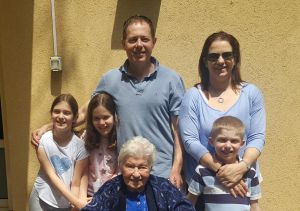 Slade, 55, was born in Israel. He now has three kids and is retired in Westport, Ct., to a life of work. He is on the board of AIPAC and Maccabi World Union and American Friends of Reichman University. “I spend a very big chunk of my time and money trying to support the Jewish people,” he says.
He is at these games on the Masters 40+ Table Tennis Team. He is loving it more than anything. His son is here, too, playing U17 Table Tennis.
Everywhere he goes, he sees people he knows. A friend from Harvard business school is playing tennis; a childhood friend from Israel is on the Israeli tennis team. One of his friends from Connecticut is swimming.
Slade loves talking to the other people around. He finds people in the elevator, people he sees on the street wearing the Brazil shirt or the Mexico shirt or one of those ever-present floral-colored credentials. He goes up to them.
What team are you on?
What sport do you do?
“Everyone’s super friendly,” Slade says. “We end up having 10 or 20 minute conversations.”
And the Opening Ceremony. What an event. “They have the Bruce Springsteen ‘Born in the USA’ music in the background, and everyone’s cheering ‘USA, USA, USA,’ and being there with all the athletes—thrill of a lifetime.”
Slade has always been a go-getter. He once concocted a (nearly successful) plan to gain citizenship in Ecuador, make the national basketball team, and play in the Olympics — all to get into business school at Harvard. When that failed, he tried out (also unsuccessfully) for the inaugural Maccabi USA field hockey team for the 1993 Maccabiah.
So making it into this Maccabiah? This was doable.
***
Slade has thought about his grandparents all the time since being here. But why only now? Why did he not make this plan happen before?
Well, he was working. He was busy. Four years ago, he retired, and that freed up time, and then he became aware of the older age bracket at the Games, and then team sizes shrank because of the war. All these things created possibility.
Slade called people at Maccabi USA. “Hey, I want to try out,” he said. “Is there room for me?”
 Like many who grow up with a ping pong table at their or a friend’s house, Slade can play recreationally. But making the team “wasn’t a competitive road. I probably would not have made the team if it was competitive. I’m the least competitive player on the team.”
Slade lost all three of his matches in the individual competition Monday, all in straight sets. He is not going to win a medal. To him, though, the Maccabiah is as much about supporting Israel and making connections as it is about sports.
When he decided to come, he had one additional thought.
“I asked my son if this is something he would want to do with me, and I really hope that this is going to be an experience that he’ll talk about for the rest of his life.”
Slade has orders for his son, Leo. Basically: Practice your Spanish.
“I told him his mission is to meet a whole bunch of nice Jewish girls while he’s here, and to practice his Spanish, and also meet nice girls from Argentina and Colombia and Mexico.”
Slade was pulled to these games by a profound sense of duty, but also by a quiet sense of destiny. If not for a chance meeting, an open seat in the stands, and a shared phone number at the very first Maccabiah, Gadi Slade wouldn’t exist.
“For me, just being here today and wearing the shirt,” Slade says. “That’s my definition of victory.”
Michael Liebermann is a fourth-year student at the University of Virginia from Westfield, N.J. He is a senior writer and former sports editor at The Cavalier Daily, where he primarily covers men’s basketball, soccer and lacrosse. You can find his work here and follow him on X or Instagram.