
By Ezra Lev Cohen
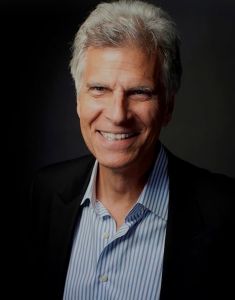
Even though Mark Spitz is one of the few people in his West Los Angeles neighborhood without a pool in his backyard, the Olympic icon still likes to dive in and talk about his swimming heroics as if they happened yesterday. Over the course of our two-hour conversation with the American and Maccabi legend–which ranged in focus from the Munich massacre to the Space-X IPO and to the state of the Jewish world right now–it became clear to me that Spitz’s life is best understood by his relationship swimming–and in particular, his experiences as one of the few Jewish athletes to ever make a serious wake in the water.
Part 1: The First Maccabiah
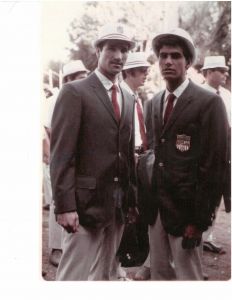
Spitz’s first splash as a Jewish swimmer came in 1965, when the 15-year-old traveled to Israel for his first Maccabiah. His goal was to prove himself to the Jewish world as a serious competitor. Spitz was relatively inexperienced in the water, but as far as the other requisite for Maccabiah competition went–being Jewish–he had a good handle on things. Two years earlier, Spitz had celebrated his Bar Mitzvah in Oakland, California, where he’d grown up. Though Jewishness, for Spitz, was a chore, it came with a built-in community. “Misery loves company,” he says, “so all my friends were doing the same thing, and so from that point of view, I’ve got a lot of fond memories.” By the end of the ’65 Maccabiah, the Jewish world knew all about Mark Spitz and his feats in the water. Despite competing against swimmers of all ages, Spitz returned home shouldering 4 gold medals and the Games’ Outstanding Athlete award. It took two more years of intense training under an Olympic coach and a family move to Santa Clara so Mark could train with a prestigious team, until the non-Jewish world also learned of Mark Spitz.
Part 2: The Breakout
No one expected his breakout to come two years later, when the 17-year-old crouched on the starting blocks in California alongside Don Schollander, the world record holder, preparing to swim a 400-meter freestyle race for a preseason exhibition event. His expectations for seriously competing with Schollander were low, and Spitz’s coach, George Haines, encouraged him to swim his own race.
“‘Just hang there with him and when you feel like you can move away from him, just do it. He’ll go out too slow and he’ll just race you down and beat you,'” Spitz recounted about that advice. Halfway through the race, though, Spitz found himself two body lengths in front of Schollander. “God,” he thought, “I’m not even expending energy!” He pushed his arms faster, and with two laps left was five lengths ahead. When he hit the wall, he looked at the clock and saw 4.10. He’d broken Schollander’s world record by two seconds. As he climbed out of the water, his coach took him aside. “He said,” Spitz recalls, “‘Today’s Sunday, tomorrow Monday. The world will know that you are the world record holder. You just went from the hunter to the hunted.'”
But this new position saw him flounder a year later at the Mexico Olympics in 1968. To be sure the stage was enormous and the expectations were high. But there were also rumblings of antisemitism and jealousy he remembers sensing from his teammates.
“I was favored to win eight six gold medals as an 18-year-old,” he explained. “You could feel the tension.” Spitz managed to take home 2 gold medals for relay events, along with a silver and a bronze for individual races. But it wasn’t the dominant performance people anticipated. He resolved to never let the jealousy of others and especially matters of Jewish identity get in the way of his success.
“I let my sports and activities sort of speak for themselves, and if the tagline was the fact that I was Jewish, that was fine,” he admitted.
Part 3: Triumph and Tragedy
Three years later, however, at the 1972 Munich Olympics, Spitz’s need to grapple with his Jewish identity became unavoidable. By then he had competed for a second time at the Maccabiah, though it was characterized by a serious lack of sleep as a triumphant Spitz reveled in his newfound status as an Olympic gold-medalist.
“There [were] a lot of girls running around,” he remembered. “I met this girl from Australia [who] was a swimmer, and I thought I’d fell off a cliff in love, you know?” He “didn’t get enough sleep or warm-up properly” due to these distractions, which he points to as the primary reasons he failed–by a tenth of a second–to achieve his goal of being the first to break a world record on Israeli soil. Still, the medals continued to dangle proudly around his neck; he took home six golds and a second consecutive Outstanding Athlete award
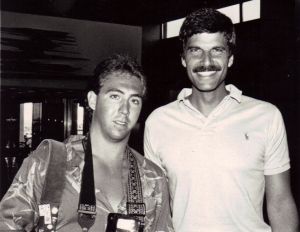 At Munich things initially went better than he could have imagined. He swam races on seven out of the first eight days and won seven gold medals and broke seven world records. The night of Monday, September 4th, Spitz went out to dinner with a photographer and some friends from Sports Illustrated who’d chronicled his career. He’d just won his final gold, and his competitive obligations were over. He was planning to leave Munich early in order to return to dental school in Indiana, from which he’d gotten a brief leave of absence. He recalls that the dinner was celebratory, and that he returned to the village around midnight to rest up before a closing press conference early the next morning.
Four hours later, and unbeknownst to a sleeping Spitz, eight Palestinian terrorists from the Black September group snuck into the village, killed two Israelis, and took 9 hostages from the Israeli delegation. So, when his press conference started five hours later, rather than reveling in his victories, Spitz was tossed into a different role from inside the chaos. “They wanted to know what I saw, because I was like a messenger because it was a blackout or a lockdown for any information on what was going on in the village,” he explains. And rather than discussing his achievements with ABC host Jim McKay, Spitz sat and watched a camera feed as crisis negotiators worked on the situation. Amidst the adrenaline, it dawned on Spitz that, “I was involved in an interesting situation–especially being a Jew.”
The German government was apparently concerned as well. Upon returning to his room, he found the Prime Minister of Germany, who indicated that they had an emergency evacuation flight scheduled for Mark given his high profile status and Jewish heritage, which marked him a potential target. “They kept saying on the TV that Mark was in Italy and Mark was in Switzerland–I mean I was nowhere where they said I was. That was just some PR that they were giving that I wasn’t in the village to get somebody off the scent, so to speak,” he detailed. If his descriptions sound tumultuous, it’s because Spitz truly was bewildered at the sequence of events. Hours later he found himself bouncing from London to Los Angeles where he was greeted by Governor Ronald Reagan on the tarmac, and quickly escorted onto another flight packed with journalists to Sacramento.
Forty-eight hours later, Spitz felt confused. “I’m sitting at home with my sisters watching it on TV and watching a memorial service coming from the stadium that had happened that day and I’m going, “This is sort of an out-of-body experience. I was in the Olympic Games and here I am in Sacramento, California watching all this.” And 46 years later, Spitz is still upset by what he experienced. “That moniker of being involved–[given] the fact that I won all these medals–always surrounds me, [even] as we’re talking about it today,” he says. “It’s not something that I can shed off lightly–nor do I want to–about the extreme tragedy that took place.”
Part 4: Maccabiah Redux
Reverberations of Munich filled the atriums and corridors of the massive Teddy Stadium thirteen years later, when Spitz stood, now at his third Maccabiah, lifting the flickering torch and preparing to jog in to light the symbolic flame for the 1985 Games.
By this point he was 35, and retired from competitive swimming for almost thirteen years. Spitz left competitive swimming after the Munich Olympics, at the age of 22, for a simple reason: “There was no future for me to go on,” he explained. “You know, I wasn’t chasing Mark Spitz.”
He’d won all he could. In the aftermath, he took up international offshore sailing, during which he sailed between California to Hawaii three times. He met and married his wife, which “was way more important” than anything he’d ever done, and had two boys with her. He licensed his name, and went on speaking tours around America. He founded a swimsuit company under the umbrella of Adidas footwear. Then he transitioned to real-estate, and then to a spate of start-ups, including a pre-paid phone company which was eventually bought by AT&T, and then he became a stockbroker and now manages his own portfolio. The Space-X IPO was endlessly fascinating to both of us.
As he now stood at Teddy Stadium with the torch, accompanied by three girls whose fathers had been members of the Israeli delegation murdered in Munich while Spitz slumbered, the lights in the massive, 30,000-seat stadium went dark. “It was pitch black other than a couple of incandescent lights that were sprinkled throughout the stadium, just enough to where you wouldn’t trip on anybody if you went to get a bag of peanuts.” As Spitz recalls, the lights were a variety that took 25 minutes to turn back on. Eventually, mutterings of impatience spread throughout the stadium, and the organizers told Spitz and the girls to commence their run.
“Well, this crazy torch that I had was quite great,” Spitz explained. “By the time I got around, the lights had already come. And everybody said, ‘God, that was the greatest effect in the whole world. Did you know that that was going to happen?’ I go, nope. We didn’t practice that at all.”
From the darkness of Munich came the brightness of Jewish togetherness.
Part 5: The Last Maccabiah
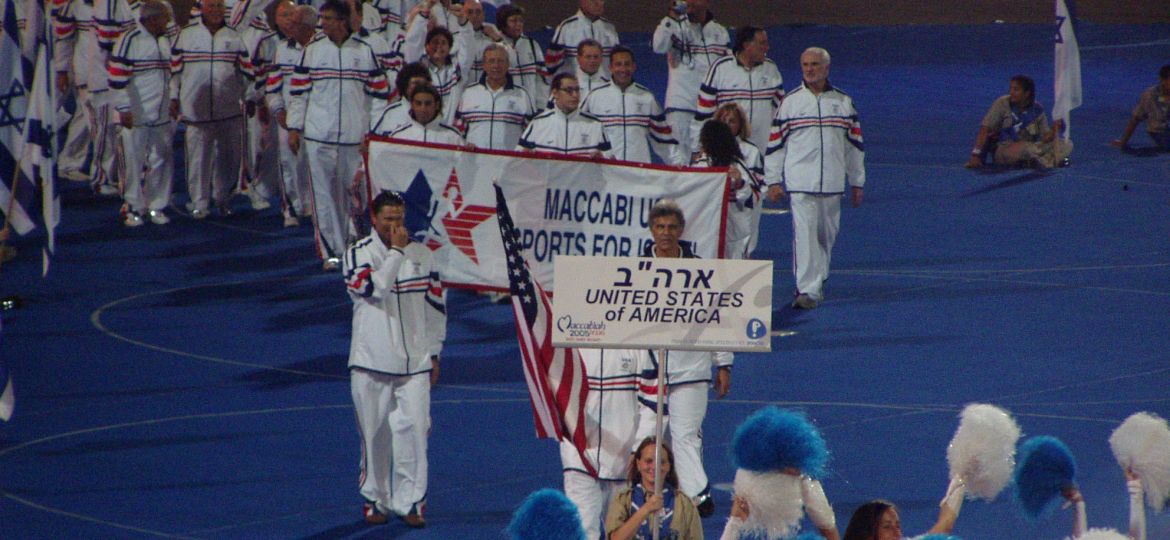
 “There were bombs going off in 2005 when I was back [in Tel Aviv] as a guest for the Maccabi games,” Spitz recalled, about his guest-of-honor invitation back to Israel two decades ago. “It was rattling the windows.”
Long gone were the days when he could separate his Jewish identity from who he was. He understood the importance of the Maccabiah in the context of the ongoing threats that Jews faced. “Antisemitism has been going on for 5000 years,” he tells me. “Jewish people have this moniker that they wear, unfortunately. But we’ve done a great job of somehow getting through our lives,” he explains “The Jews people have always had a philosophy of being a participant in lieu of the fact of hardships. And we overcome those things, you know?”
All this leads him to a simple conclusion, that became clear even then as he watched the Maccabiah from the stands alongside dignitaries including Prime Minister Ariel Sharon: “That, to me, is the most important reason why the Maccabi Games must continue.”
It was his fourth foray to Israel, and his last, at least for the time being. At 76 years of age, there’s plenty of time for him to make another appearance. In the meantime, he continues to think about his life and his impact on others. He didn’t embrace his Jewish identity, especially during his younger years. But in the context of his record-breaking performances, his heroism in the Jewish community, his complicated experiences in Munich, and his different experiences at Maccabiah, Spitz’s sense of self and his connection to Judaism have forever changed. He understands that perseverance is an essential part of the Jewish story, and he believes sports offers the opportunities for community that help make this perseverance possible.
Sports “unites people way more than [they] separates people,” he acknowledges. “And because of the unity of it, it brings the culture of the Jewish people together.”
Portland native Ezra Lev Cohen is currently studying abroad at Hebrew University in Jerusalem and reports for The Press Service of Israel as an intern. He’s a rising senior at Macalester College, majoring in Journalism and Geography. Find him on Instagram at @ezzy_reports and email him at: ezzycohen@icloud.com.