
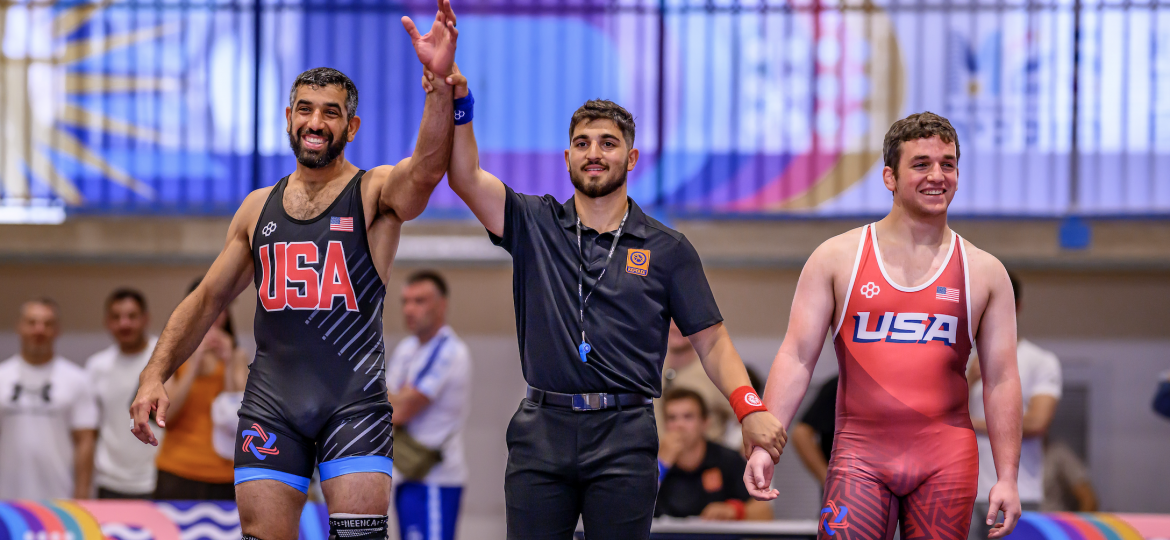
Elite wrestlers do not come from Yeshivas in NJ. Until this Maccabiah.
By Michael Liebermann
Noah Lebowitz had sweat on his back, sand on his shorts, and a beer in his hand. Standing on stone bleachers at Israel’s Wingate Institute, he looked over a giant sand pit normally reserved for beach volleyball.
He sipped his tallboy Corona, and next to a cooler nearby sat someone else’s Goldstar. The USA’s eight wrestlers at the 22nd Maccabiah specialized in folkstyle or freestyle or Greco-Roman — not one of them had ever wrestled in a sand pit. Beach wrestling was a bonus event for them, so they were drinking a little.
Lebowitz’s whole career in wrestling, you might say, is a bonus. He picked up the sport by chance at Torah Academy of Bergen County. Twenty-two years earlier, MB Klyman did the same thing at TABC. And one grade behind Lebowitz came Daniel Delman.
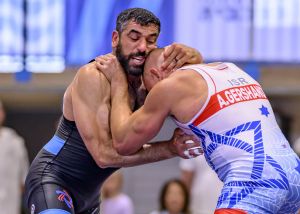 The three wrestlers, graduates of the same small Yeshiva in Teaneck, NJ, all wrestled for Maccabi USA at this Maccabiah. For the first time in anyone’s memory, about half the team’s wrestlers came not from big public schools but from small religious schools — the same one.
Lebowitz was up in the bleachers at Wingate, his day done. He had not had his best event, going 1-3. But he was watching the last few matches, his green shades on.
Klyman stood inside the ring. A bus rolled up earlier and spilled out dozens of camp kids, including one of his sons, and now chants rolled down onto Klyman, all for the 40-year-old with the beard and the taped knee and the kids braying his name — “M-B, M-B, M-B.” This was his third Maccabiah. He is getting older, and he is relying as always on mantras, like this one from Maccabi USA Coach Rob Prebish:
“Win or lose, you are allowed five minutes after your match. You take five minutes, and after that, it’s back to the lab again.”
Delman stood on the sand, against a fence. It just so happened that in those five minutes after a match during the freestyle competition, Delman punched a wall and broke his hand. He is out for four to six weeks. But he is approaching it with perspective.
“I’m still gonna be in the room supporting my friends and watching wrestling,” Delman said. “I’ve had injuries before, and these are just roadblocks. You gotta find a way to find another route, go with the flow, find a better way to deal with it.”
That summarizes life as a wrestler from TABC. Alternate routes. Figuring things out. Yeshiva wrestlers are not supposed to be here. They’re not supposed to be wrestling in college, like Delman will at Muhlenberg, like Lebowitz might at Binghamton, though a coaching change has thrown it into question, like Klyman did at Rutgers.
“We’re at a severe disadvantage,” Klyman said. “We finish school at five. We don’t have the same facilities as other schools might have. We don’t have trainers all the time. We don’t have sports budgets, mainly because the school doesn’t necessarily see the benefits the same way.”
Klyman is intimately familiar with this, not just from his time at TABC. He is now the head coach at Frisch, a Yeshiva in Paramus, NJ, 12 miles down the road from TABC, that faces all the same problems.
Secular studies run until midday. Then religious studies take over until 5 p.m. Practice time is limited to two to three days per week, and it has to be approved each time by the school to make sure it’s not interfering with the curriculum. There’s not even time for a weightlifting program.
Those are the logistical hurdles, and yet the bigger impediment to wrestling is more fundamental — the kids don’t get it. What they get are basketball, floor hockey, flag football. Wrestling? Cutting weight and throwing guys over your head and jogging around school in a garbage bag? “It’s like, ‘What are you talking about?’” Klyman said. “‘I’m gonna do what?’”
Klyman loves the calls he gets from parents.
“My son, he told me he has to cut two pounds by next week. But I told him he can have yogurt. Yogurt is healthy. Like the fat-free yogurt. That’s fine, right?”
Jewish mothers are not accustomed to helping their sons lose weight.
“By the time our guys are seniors in high school, they’re high-level JV,” Klyman said.
Lebowitz planned to join the basketball team. In eighth grade, in fact, he was lifting weights at Klyman’s gym in Tenafly, NJ, where Lebowitz’s mom worked at the time, when Klyman came up to him.
“Oh, you should come to Frisch,” Klyman said. “Be on the wrestling team.”
“And I was like, ‘I don’t know, I’ll probably try to do basketball,’” Lebowitz remembers.
But Lebowitz tried out for hoops and got cut. Then one day the mats came out in gym class, and he started beating up on all his friends, and everyone told him to go try out for wrestling.
He quit after a week. He went to two practices and decided what most other Yeshiva boys know without even stepping on a mat: “This sucks.” The guys on the team? Weird. The practices? Painful. The sport? Also weird.
But his sophomore year, at the urging of Coach Ezra Kapetansky, he tried it out again and decided he liked it. He only knew three moves that first year — half nelson, double leg and stand up — but they were enough, for a wiry guy at a light weight class, to take him all the way to the final of the Henry Wittenberg Invitational, the national wrestling tournament that combines all 16 schools in the Yeshiva Wrestling Association.
He “choked” the match. Needed to pin the guy in the first 30 seconds, and let him get away. “No gas tank.” That hurt. He was hooked.
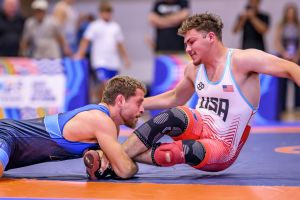
Lebowitz ended up winning the Wittenberg his junior and senior years. Delman won it his senior year. The two became natural partners in high school, driven together by their shared situation: “No one else on the team really took it as seriously as us,” Lebowitz said. Despite an age difference and a massive weight gap, they sparred every practice. At club tournaments, too, they were the only guys who were Shomer Shabbat, and they stayed in the same hotel room last year when they tried out for the Maccabiah.
“He’s an amazing friend of mine,” Delman said. “I’ve been friends with him for many years, and we’ve basically done everything together, and also we’re here at the Maccabiah.”
Delman was the exception at TABC. His dad wrestled. His mom’s brother wrestled in Argentina, and his dad’s brother wrestled at Ohio State. He picked it up in middle school.
He is not new to the concept of being an athlete and an Orthodox Jew. Even before wrestling, he played tackle football. (He was good, too, the starting center for his junior football team, so much so that the local high school football coach visited a practice and came up to him to ask about his plans for high school. TABC was not exactly the answer he was hoping for.)
At team dinners, Delman would be the one kid with no food on his plate. “I had my kippah on, my tsitsis out,” Delman said. “I’m the Jewish kid who keeps kosher and keeps Shabbos.”
It was hard for people to believe he could do both. Now they don’t believe he can be Orthodox and a wrestler.
“I’ve had so many people say to me, ‘Oh, you can’t do it,’” Delman said. “And it’s like, ‘Okay. Well, I did.’”
He is intensely focused on his own wrestling and his own self-improvement. But he also wants to be a role model. He sees the young Israeli kids that came up to him during the Maccabiah. Just by doing it, he wants to show people that it’s possible.
“If I can bring Judaism to the people who are Jewish wrestlers and don’t really have that in their life, and then also wrestling to people who just have Judaism and don’t really want wrestling in their life, that’s the thing I want,” Delman said. “I want to breach those barriers and really bring it together.”
His competing here? That’s a start toward combining those two worlds. Coach Rob Prebish wants to help serve as a bridge, and Klyman, of course, is tremendously on board with the whole idea.
Until this year, Klyman was the only Shomer Shabbat wrestler involved with Maccabi USA. He is also — according to Kapetansky, the former coach at TABC — the longest-competing wrestler from a Jewish high school in America.
It is not a mantle he needs to shoulder alone as much anymore.
“I love it because it’s a little less lonely for me sometimes,” Klyman said. “That people out there share my passion as well, that it’s not just me out there trying to grow these sort of things, but other people out there also trying to do more.”
In his years, he has seen a thing or two. He started because he was “too fat to make any other sports team.” When he started the sport, a single pushup defeated him. It took him two and a half years to win his first match.
He has broken his back twice, broken his nose 13 times, been paralyzed in his right arm, had concussions and disk ruptures, torn meniscuses and MCLs and hip flexors.
The worst was his senior year at TABC. He had an undefeated season going, and then midway through one match, with Klyman and his opponent locked together, his opponent’s leg slipped, torquing Klyman’s lower body one way and his upper body the other way. His L2 and L3 vertebrae shattered. The remedy was a full-body cast, leaving him stuck in a bed for three months.
Most would have quit.
“When you’re just lying there for three months, you have no choice but to either feel bad for yourself or to play through situations in your head,” Klyman said. “I can’t fix what happened. It’s already happened. But what can I do in the future to guarantee success?”
His mother offered tennis.
“That’s not a thing,” he said. “We’re gonna be here.”
Klyman went to Israel for a year after he finished at TABC, as is customary, to study at a Yeshiva. He came back and was supposed to wrestle at Rutgers. But the coach there gave him a choice: He could either be Sabbath observant or wrestling observant.
He chose the Sabbath.
He started a wrestling club at Rutgers that never competed on Shabbat.
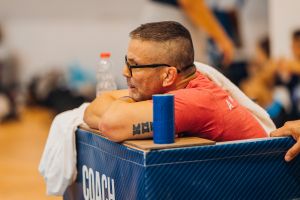 Wrestling has become Klyman’s life. He coaches at Frisch, runs a wrestling club out of DII Felician University, and operates a gym in Tenafly, NJ, called Underground Training. In 2017, he wrestled for Canada at the Maccabiah, and in 2021 he switched his allegiance to the United States. He loved competing at this Maccabiah.
One of his younger sons came with his camp to watch beach wrestling. Klyman’s oldest son, however, is entering high school next year, at Frisch, and Klyman hopes to wrestle with him at the next Maccabiah.
That’s still a few years away for the aging wrestler. Is he ever going to stop?
“Absolutely not. There’s no stopping. You can’t stop. The second you stop is the second you’re done. You give in. In everything, right? That’s when you’ve lost.”
Kapetansky, Delman and Lebowitz’s coach at TABC, made aliyah after Lebowitz’s sophomore year and Delman’s freshman year. He came to Wingate to watch his former wrestlers compete. There were three days of wrestling at the Maccabiah — freestyle, then Greco-Roman, then beach.
Delman could not compete after his injury in the freestyle competition. Klyman took a bronze in freestyle and, two days later, a bronze in beach with his son watching on.
Lebowitz missed the podium in all three competitions. After winning his final match in beach, he had a chance to keep advancing if one of his previous opponents won and pulled him through. But the guy lost. So, like any good wrestler under Prebish, Lebowitz took his five minutes.
He used them to drink his Corona. Wrestling might be weird. But for these guys from TABC, it has become a way of life.