

By Zachary Karpf
When is it ok to quit? When is an acceptable point to give up? When you have nothing left? When you think you can’t go any further?
There isn’t a true answer to these questions. It changes depending on severity, time and circumstance. However, when you have no other options, when you feel empty, quitting becomes an almost taboo thought process.
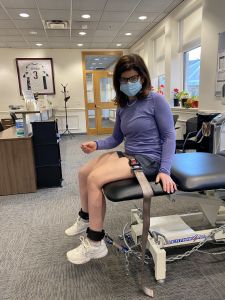 When Dr. Janet Pearl lost all muscle function in her left quad after knee surgery in 2021, it could have signaled the end of her athletic career. She could have attributed it to fate and moved on. She could have lamented and done nothing. She could have quit.
Pearl is a third-generation American Jew, as her grandparents immigrated from Eastern Europe and settled in Boston. Her grandfather and father both served as temple presidents and her mother was president of her sisterhood. Pearl learned the importance of leadership in the Jewish community and the mother of two now serves on the advisory board at Temple Emanuel in Newton, Massachusetts, and is also a member of another local synagogue, Shaarei Tefillah.
It was the love of Judaism instilled in her by family, coupled with two trips to Israel before attending college, which drove Pearl’s desire to compete in the Maccabiah, which she will do this summer as a member of Maccabi USA’s Masters Tennis team. Now, her motivation to attend the Games is even greater due to the crises that have plagued the Jewish people over the past few years, including the rise of global antisemitism and anti-Zionism.
“I think, for all of those reasons, and the events of October 7, I wanted to go even more,” Pearl stated. “I wanted to say that I’m standing up with those in Israel, to say that they’re not alone. We’re here.”
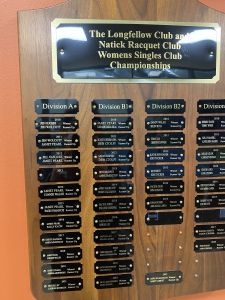
Before Pearl set out to compete in Israel, her name became synonymous with Boston-area club tennis. Since 2011, she rose through the ranks of The Longfellow Club and Natick Racquet Club’s Women’s Singles Club Championships.
After posting back-to-back runner-up placements in 2011 and 2012, Pearl won five championships from 2014 to 2021, including three straight titles from 2014 to 2016.
Now, at 61 years old, the Wellesley, Massachusetts, resident is set to bring her tennis talent to the world stage. However, her journey to the Games wasn’t without its fair share of trials and setbacks. Pearl’s spot atop the club’s rankings saw an abrupt end in 2021 after she suffered a knee injury, prompting a swift exit from competition. A large section of cartilage broke off, leaving a space resembling a pothole inside her knee.
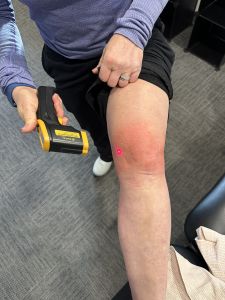 “First of all, it was swollen,” Pearl explained. “That’s when I figured out something was wrong. I tried to play on it, but I realized my knee was stiff.”
After a consultation with her surgeon, Pearl determined surgery was necessary in order to move forward with her recovery. Her surgeon suggested a type of surgery titled “OATS,” or osteochondral allograft transplant surgery. In essence, cartilage is taken from a cadaver and transplanted into the osteochondral defect in the patient’s knee. After a successful OATS transplant, approximately 80% of surgical recipients could return to sport within six months.
With hopes rising post-surgery, Pearl began physical therapy just a few days after her procedure, but things didn’t turn out exactly as planned.
“I went to PT and the therapist said, ‘OK, lift your leg.’ My leg went up, and I said, ‘I don’t know if you’re doing that or if I am.’ My therapist said it was him. He just lifted it and I couldn’t move it at all,” Pearl added. “I couldn’t contract my quad.”
After speaking with her surgeon, Pearl was reassured that this kind of quad inhibition was common in patients post-operation. However, after multiple weeks of physical therapy and rehab, Pearl still had serious concerns about her lack of mobility.
The reason behind Pearl’s movement trouble was a largely unknown condition called Arthrogenic Muscle Inhibition. In essence, AMI occurs after surgery when certain muscle groups surrounding the affected joint continue to malfunction.
“It was weeks (after), and I still couldn’t move (my quad),” Pearl said. “I started getting a little panicky, so I said to my surgeon, ‘Can we talk about this?’ and he said no.”
For Pearl, it was disheartening to feel like her concerns were reaching deaf ears. The medical professionals who oversaw her life-changing surgery and recovery didn’t provide any solace. At age 55, Pearl’s dreams of returning to her former glory at her local club and eventually competing in Israel were fading quickly.
Since Pearl, a Harvard graduate, is a doctor in her own right, specializing in Interventional Pain and Regenerative Medicine, she began doing her own research and after contacting a physical therapist in New Zealand who had written a comprehensive medical paper on AMI treatments, she finally found a roadmap to recovery.
“Every time I woke up in the morning, I told myself, ‘I want to go to Maccabiah. I’m going to get there,” Pearl said. “I wanted to go to Israel and compete with other people my age. I kept telling myself, ‘How meaningful would that be?”
It took Pearl five years to discover ways she could work out and rehabilitate her knee to gain motor function. She used techniques like icing the knee immediately before working out or playing tennis, and bone marrow injections with PRP (Platelet-Rich Plasma) to stimulate accelerated healing in her knee and quad.
 “It’s been really good. I’ve gone from not being able to move my leg to returning to singles tennis,” Pearl exclaimed. “I recently played four hours of doubles and a little singles, so it feels good.”
With the Games’ Opening Ceremony set for July 1, Pearl is close to her dream being realized, walking under the American flag, surrounded by Jewish athletes representing their country in competition.
“I’m ready to go,” Pearl said. “I’m still getting better. I’m going to be even stronger.”
Zachary Karpf is a recent Penn State Bellisario College of Communications Graduate from Lansdale, Pennsylvania. Follow Zach at maccabiausa.com, on his socials at @Zach_Karpf03 on X, or connect with him on LinkedIn