

By Josh Markowitz
Shane Carr doesn’t march at the front of the U.S. delegation at the Opening Ceremony anymore. As the Senior Director of Programs for Maccabi USA and the lead professional for the 2026 Maccabiah, Carr could claim that spot. Instead, he gets the most joy from being in the back, where he can watch athletes and volunteers walk past. This is where he sees how his years of planning have turned into something meaningful and sometimes life-changing.
“I want to see the look on their faces,” he said. “And to me, that’s really fulfilling, to see all of the hard work paying off.”
 That instinct reveals a lot about how Carr sees his job. He is one of the operational backbones of Maccabi USA, but he talks less about prestige than he does about the responsibility that comes with his role. His work stretches from housing requests and flights to apparel, medical staffing, and the promise that everyone comes home safe. Decades before Shane joined Maccabi USA, his outlook was shaped by his Jewish summer camp experience, his nearly nine years with the Union for Reform Judaism, and his semester abroad at Tel Aviv University, which he describes as transformative to his values and sense of purpose.
Before joining Maccabi USA, Carr spent nearly a decade with the Union for Reform Judaism (URJ). After four years at URJ Camp Harlam in Pennsylvania, he spent the rest of his time with URJ in a different role, as a founding member of a new non-profit youth summer program called 6 Points Sports Academy in North Carolina. At 6 Points Sports Academy, he learned how sports, Jewish identity, and community could live in the same place. At Maccabi USA, that same idea expanded from a camp setting into a global one. What drew him in was not just the scale of the event, but the chance to build community through sports and Judaism at the highest level.
 “This [joining Maccabi] takes that same experience and magnifies it to where it’s really excellence in Jewish sports and makes it global,” explained Carr. “So it’s not just North American Jewry we’re dealing with, it’s global Jewry.”
As the 2025 Maccabiah approached, his mission carried unusual weight. Carr had spent years preparing for what was supposed to be a gathering shaped by October 7 and its aftermath, not just a competition, but a chance for Jewish athletes from around the world to join together in Israel. Then, days before departure, the Games were postponed due to the war in the Middle East, and the work Shane had poured into the event was suddenly suspended.
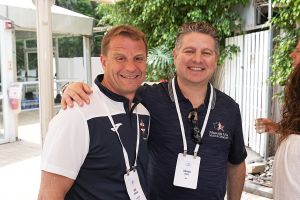 “There was a lot of trepidation of the unknown,” he revealed. “And leaving the United States for Jews at the time was really nerve-wracking. Which is so different when the Maccabiah is supposed to be and still is a fulfillment of this longing to be together as one group.”
He describes the aftermath with the sports metaphor of playing goalie. Instead of celebrating a finished job, he found himself fielding questions about safety, refunds, timing, and uncertainty from athletes and families who yearned for answers. He also carried a simpler frustration: after years of work, Shane still did not get the satisfaction of seeing his work come fully to life.
“And all these questions are completely valid,” he added. “Because people, first and foremost, are concerned about their safety.”
That frustration helps explain why Carr talks about athletes in such practical terms. He knows much of his relationship with them can feel transactional, centered around forms, money, logistics, and deadlines. But he wants them to understand that his priorities are care, safety, health, and connection first. The medals come later. His job, as he sees it, is not just to get people to the Games. It is to give them an experience of a lifetime and to get them home again safely.
“What I would like them to know is that I am dedicated to providing care for you,” he said. “I want you to be safe, and I want you to be healthy. I want you to have a great time, meet lots of people, and make lifelong friends. I also want you to compete and win a gold medal.”
The clearest example comes from the Pan-American Maccabi Games in Santiago, Chile, in 2015. A junior athlete became dehydrated just before the Opening Ceremony, and Carr stayed with her in a medical triage room while she received an IV. She recovered in time to make it to the ceremony. This is one example of Carr realizing his responsibility to the delegation mattered more than his own place in the parade.
“I think that’s when my vision of not marching with the delegation began,” Carr noted. “Because I realized that my responsibility to this athlete was not over, and I still had to wait and make sure that she could get through this.”
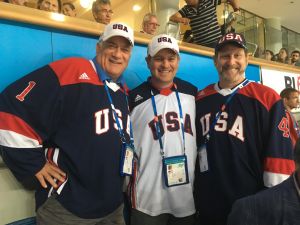 That story still shapes the way Carr moves through the Maccabiah. He plans to be the last person in the delegation to enter the stadium at the Games this summer, partly out of humility but also to make sure no one is left behind. For Carr, the event is ultimately about care and connection, and he hopes athletes leave with not only memories of competition but also relationships that show just how wide and interconnected Jewish life can be.
Josh Markowitz is a third-year student at American University from Briarcliff Manor, N.Y. He is a double major in Communications and Photography with a minor in Marketing. He is a staff photographer for the American University Athletics Department as well as a photographer and assistant multimedia editor at The Eagle, American’s official newspaper, where he covers sports and news events on campus and around D.C. You can find his professional portfolio on his Instagram account.