
By Michael Liebermann
Marshall Einhorn, Maccabi USA’s CEO, never opened his apparel package. It arrived last year and just sat there, the Maccabiah 2025 t-shirts and shorts and quarter zip all folded up in their plastic, for 15 months.
The night before Einhorn flew to these Games on June 24, he opened the bag. By that point, he had known for a couple weeks that things looked good. The Games, despite a year’s roiling uncertainty, were likely on. But when Einhorn opened the bag, it hit him. The adrenaline.
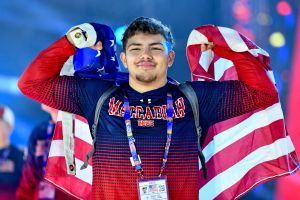
 “As I was packing, that’s when the emotion started,” Einhorn said Wednesday, wearing two of the clothing items. “I knew I was going to be here to take in this great event.”
He jetted off the next day, from Newark Airport, on Maccabi USA Advance Team B. That was six days before the Opening Ceremony. It came after a month of doubt.
After last year’s Twelve Day War came and wrecked the Games.
After the barrage 24 days ago, when nearly 30 ballistic missiles lit up the Tel Aviv night. The threat of conflagration has not gone away. But “More than Ever,” as the slogan goes, the Games go on.
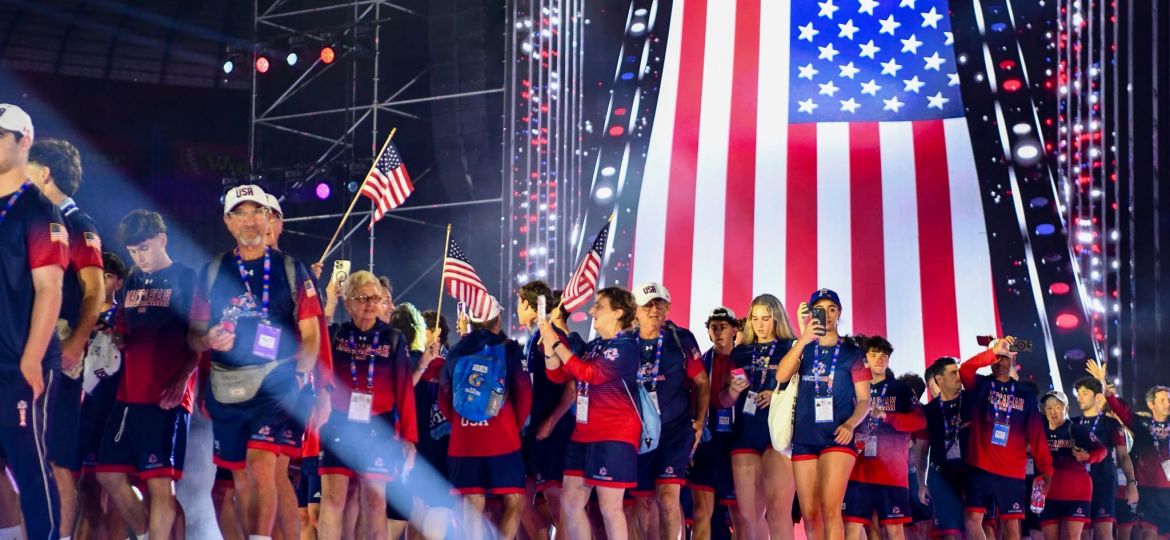
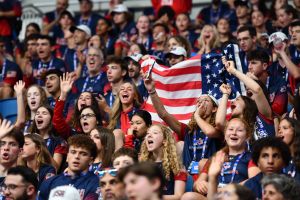
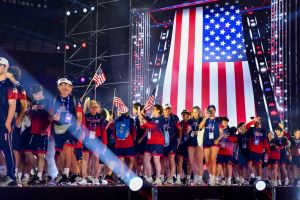
Wednesday night, at the Opening Ceremony, buses flowed into Jerusalem, clogged with nearly 1,000 Maccabi USA athletes, staff and supporters. This was happening. This is happening.
Larry Lederer can hardly believe it. He was scheduled to come last year, like many of the athletes competing, and checked the news so frequently he made himself take a day off two weeks ago — “mentally, I needed to just settle in,” he said. His wife was too worried about security to come. But as the Masters tennis player watched the flow of people in Pais Arena in Jerusalem before the Opening Ceremony, his heart swelled with hope.
 “To see [the young] generation here and interacting with [the young] generation from other countries, it’s why we’re here,” Lederer said. “In addition, to support Israel, just by our presence, that’s the little we can do. And it’s just an amazing experience.”
Lederer stood next to Aidan Levine, age 66. They met two days ago and struck up such a quick friendship they were paired together for doubles.
Levine, like Lederer, was scheduled to come last year — and did make the journey despite the postponement to visit relatives. “This time it’s even better, because there’s actually all these people,” Levine said.
Levine sent off a picture of the Armenian delegation to his friends from Armenia. He and Lederer are staggered by the amount of countries represented, people from Gibraltar and Brazil and India. Azerbaijan sent one athlete (he traded his clothing rapidly).
One hundred yards away, what seemed like half the Argentina delegation was mosh pitting to “Am Yisrael Chai.” Below in the arena, drummers played to the medley of colors ringing the arena. Ari Einhorn and Sampson Knopf, U19 baseball players, stayed seated, watching the show.
 They both were on the roster last year. And over the last few weeks, “I was trying to be optimistic,” Einhorn said. But “thank God we’re here.”
Sleepless on the plane, slogging through the long flight as the sky passed outside the window, it hit Knopf. “It was like, ‘Wow, I’m really gonna be there. This is gonna happen.'”
It took a little longer — just a few hours — for Einhorn.
“When I landed, it really hit me,” he said. “Like, Oh my God, I tried out for this two years ago, and now it’s really happening. Like, playing baseball in Israel. What’s better?”
From Pais Arena, athletes from 43 countries walked to 33,000-seat Teddy Stadium. The American delegation waited in a cement tunnel that sloped up to the field. “USA” chants bounced off the walls.
When did it feel real for Shane Carr?
“Right now,” Carr, Maccabi USA’s senior director of programs, said. “Minute by minute. This is when it starts to feel real, when we walk into the stadium and we see the red, white and blue. And at the end, when we sing Hatikva together.”
The American delegation emerged from the tunnel. They walked through two giant video screens as tall as the stadium’s nosebleeds. It was like parting the Red Sea.
Channel 12 in Israel broadcast the Opening Ceremony, and people occupied more than half of the 33,000 seats. The athletes filled the field. President Isaac Herzog, Prime Minister Benjamin Netanyahu, and American-Israeli former hostage Edan Alexander all spoke.
The ceremony had it all — a parade of pyrotechnics, bright spotlights, glittering performers.
At one point, fireworks rocketed from behind the stage. But in a land where loud explosions have become too commonplace, these were joyously welcomed.
Everyone sang Hatikvah. A bird flew through the stadium.
For Einhorn and staff, the past year has been grueling. It has been taxing in another way for people like the U15 girls’ soccer players who talked to their parents almost every night in the buildup to the trip about the latest development in this ongoing conflict.
On Wednesday, there was no more wondering.
“Just incredibly meaningful. Probably the most emotional Maccabiah in a generation, if not since World War 2,” Einhorn said. “The Jewish community coming together through sports. It’s just an incredible feeling.”
Michael Liebermann is a fourth-year student at the University of Virginia from Westfield, N.J. He is a senior writer and former sports editor at The Cavalier Daily, where he primarily covers men’s basketball, soccer and lacrosse. You can find his work here and follow him on X or Instagram.