

By Ezra Cohen
Golf and life: for Gary Kaye, they have more similarities than differences.
“In golf, you’re your own referee, your own judge, and so what you do when you think no one’s watching…it sort of lays bare who you are,” Gary Kaye explains. “The less [hard] you swing, the better the ball is, the more you relax, the more you trust yourself,” says Kaye, who will be competing in Masters Golf this summer at the Maccabiah. “You have to let go.”
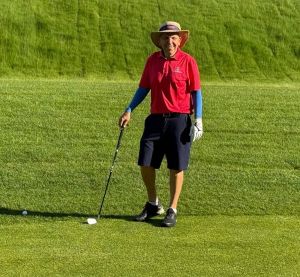 This practice of letting go and learning to trust oneself has followed Kaye from his tenuous childhood in South Africa, through his escape to Israel and ensuing successful career in New York, to the present day. Gary, almost 70 today, is preparing to return to Israel, along with his wife, Beth.
Trust, freedom, relaxation: these sentiments were often absent during Kaye’s formative years in South Africa. It was the time of apartheid, and freedom for Jews felt precarious. “We would always say, ‘Well, if they didn’t persecute the blacks, they would have gone after the Jews,’” Kaye recalls. The local golf course, where Kaye spent countless hours, had a sign which Kaye recalls as saying: “No dogs or Jews allowed.” So when he turned 19 and was recruited to the army to enforce apartheid, he secured a weeklong tourist visa to Israel with no intention of returning. Kaye landed at Ben Gurion airport in 1979 with few possessions and no real plan. What he did have was hope for a better future.
He wasn’t the first in his family to make the move. Gary’s father was a Palmach fighter who narrowly escaped death in the 1948 Israel War of Independence. “He took a plane, they didn’t fly eight hours, they took four days where they would go through different places in Africa, into Egypt, to Italy, and finally from Italy, when they flew into Tel Aviv,” Gary explained. “They were strafed by Egyptian fighter planes, and they were going along the ocean, you know, close to the water,” he recounted.
After his arrival, Gary made his way to Kibbutz Ma’abarot, where he spent the next year living communally off the land. There he met people from the USA and learned about their lives back home, and the educational and cultural opportunities in America. So with a youthful wanderlust, he left Israel for New York. “I fell in love with the place, fell in love, stayed, worked, and then, of course, met Beth.”
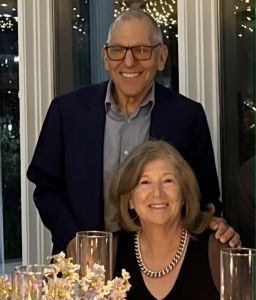 In fact, he was introduced to his future wife by a friend from the Kibbutz who had also moved to New York. Born and raised in a Jewish community in New Jersey, Beth shared Gary’s values around Judaism and Israel. As an undergraduate student, she had spent a year abroad at Hebrew University in Jerusalem. The ‘city that never sleeps’ was kind to the Kayes, and Gary in particular rose to prominence. In his late 20s, he followed his passion and earned a degree in Dentistry from Columbia University. What followed was a long, successful career, during which he built up a series of dental clinics in midtown Manhattan, invested in various technology companies, and served on various advisory boards of large dental companies.
If it was Zionism that initially brought the Kaye’s together, it was a shared passion for golf that cemented the relationship. “We both played golf growing up,” Gary explains. Beth came from a golfing family, with older brothers who were quite skilled. She’s “a really natural golfer,” he says. Gary himself has had “to work hard at it.” As the couple has eased into retirement, golf has taken on an increasingly important role: a healthy escape from daily life. “At this age, [it’s] the stage of life to have a hobby that you both enjoy together, and that’s somewhat athletic–because you’re walking 18 holes,” Gary says.
In addition to the physical benefits, Gary reaps golf’s mental benefits. He’s been attuned to the psychological aspects of golf for a while. His application essay to Columbia University was on “golf and life and the parallels,” he says. “It’s just a wonderful game to evaluate yourself, how you deal with these things, and how you can improve and master things like relaxation, adversity, and dealing with success.” He finds further connections to golf in the words of his grandfather, who narrowly escaped the Holocaust in Lithuania. He told Gary: “‘When things are good, don’t tell the whole world. And when things are bad, don’t tell everyone.’” Gary sees these same principles exposed in golf. “When you have a good shot, you don’t run and celebrate, and when you do bad, you don’t curse yourself,” he explains. This has led Gary to a balanced, thoughtful way of living, in which few decisions seem immediately black and white, or good or bad.
One thing is clear to Gary, however: the importance of Israel in his life and to Jewish life. When Gary steps to the tee-box this summer at the Maccabiah, it will be this–his love for and commitment to Israel–that accompanies him. “We spoke as kids in South Africa and even here as adults… if there was a war between our country and Israel, who would we fight for?” Gary recalls. “I would fight for Israel,” he says.
Portland native Ezra Lev Cohen is currently studying abroad at Hebrew University in Jerusalem and reports for The Press Service of Israel as an intern. He’s a junior at Macalester College majoring in Journalism and Geography. Find him on Instagram at @ezzy_reports and email him at: ezzycohen@icloud.com.